

Midway through 2026, many automotive test engineers share a common feeling: testing standards are getting stricter while time available for testing keeps shrinking.
In early May, at the 2026 International Automotive Evaluation Technology Exchange Conference concluding in Chongqing, the IVISTA China Intelligent Vehicle Index test and evaluation procedures 2026 edition was officially released, with a comprehensive upgrade of intelligent driving test and evaluation. A little over a month earlier, the 2026 Smart Chassis Pioneer Program opened in Beijing, announcing a test and verification system with full category coverage, year-round open access, and full-scenario validation. Added to the Technical Specification for Automobile Maintenance, Inspection, and Diagnosis in effect from January 2026, new national standards for steering systems taking effect in July, and new battery safety tests including bottom impact and post-fast-charge safety requirements…
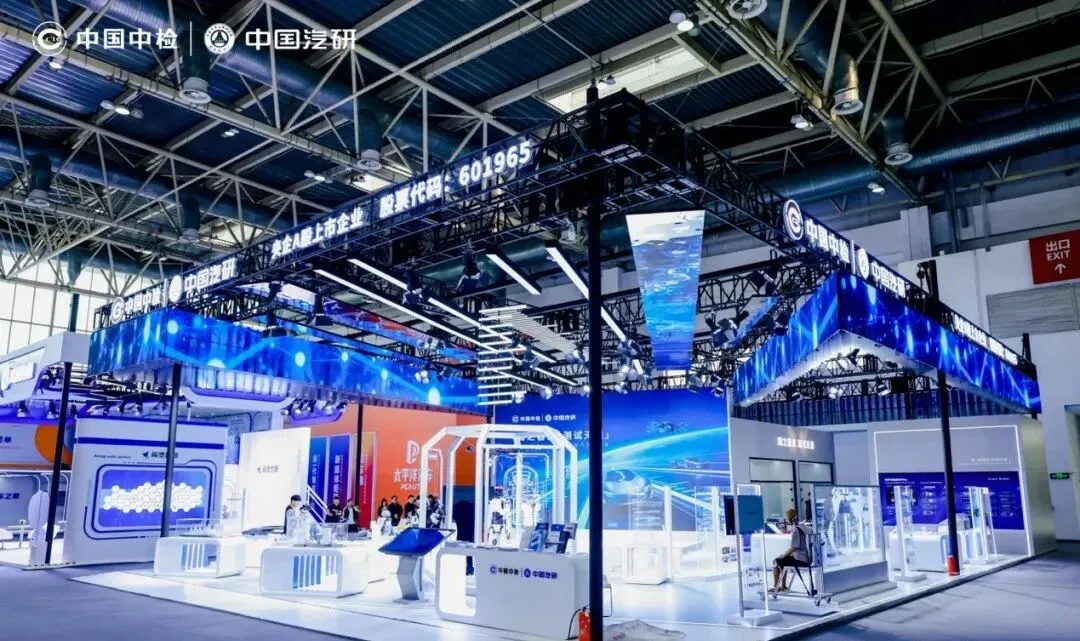
2026 (19th) Beijing International Automotive Exhibition (photosource: CAERI)
Behind tighter standards is the industry's renewed focus on quality and safety.
In recent years, under the dual pressure of "price wars" and "delivery wars," whole-vehicle system R&D validation cycles have been sharply compressed, and some steps that originally required long-term validation have been greatly shortened.
Facing ever stricter standards and an undiminished R&D pace, how can enterprises find the best balance between compliance and efficiency?
The automotive testing industry faces three key challenges
Challenge one: more and more standards, but less and less test time. From the IVISTA 2026 intelligent vehicle index to group standards for smart chassis evaluation covering extreme conditions such as fly-off ramps, high-speed blowouts, and T-junction obstacle avoidance, test teams must complete platform setup and standard adaptation within limited windows.
Challenge two: test subjects are increasingly complex, with more test tools that are hard to integrate. New-energy vehicle three-electric systems account for more than 50% of whole-vehicle cost; faults account for 67% of total new-energy vehicle fault rates—the most resource-intensive test focus. Body domain controllers are evolving from single-function control to multi-function coordination, with rising software complexity and system coupling. The traditional serial pattern of environmental testing on device A then functional testing on device B is showing low efficiency and difficulty reproducing faults.
Challenge three: more and more data, but low utilization. Onboard testing easily produces more than 100 GB of data, yet manual analysis is extremely inefficient. If data produced at great cost in time and money is discarded after collection, it is a huge waste of resources.
These industry pain points are exactly what Hefei MayonX Electronics Technology Co., Ltd. focuses on solving.
Facing frequent standard upgrades, use reconfigurability instead of starting over. Whether it is test host software that must quickly adapt to new national standards or integrated control platforms compatible with multi-brand instruments, MayonX can use modular software architecture and flexible development so customers complete standard switches at minimal cost. Test sequences can be redeveloped, flows can be drag-configured, and different product models can be adapted without code… From release of a new standard to test readiness, the cycle can be compressed to an unprecedented degree.
Facing complex system testing, use integration to break down silos. Software development integrates data acquisition, equipment control, real-time alarms, data playback, and more, supporting dozens of industrial devices including PLCs, CAN cards, motion controllers, power supplies, and oscilloscopes. Testing is no longer split into separate steps but becomes a configurable, reusable smooth chain, multiplying efficiency in fault reproduction and root-cause localization.
Facing massive test data, turn data from burden into asset. Interactive visualization analysis software built for engineers can greatly speed post-processing of sensor acquisition data; customized data management platforms can combine large AI models for fault prediction and root-cause analysis, putting costly test data to work for product iteration.
From deep analysis of massive data to precise control of low-level execution. MayonX never only sells isolated software products; it centers on customer business scenarios to build truly fit-for-purpose test solutions. With higher value for money and higher-quality products and technology, it aims to be the most trusted technology partner for customers.
The market keeps running, standards keep chasing, technology keeps changing. In this nonstop race, whoever builds an efficient, compliant, flexible test system first can seize the advantage.