


Multi-Purpose Flexible, Reconfigurable Host Test Software Based on the NI TestStand Sequence Engine
— OBC Test System Example
In on-board charger (OBC) testing, differences in test requirements across models, diverse hardware setups, and dynamic changes to test flows place strong demands on the host software’s flexible reconfiguration capability. Traditional test software binds test sequences tightly to hardware control, and flow changes require low-level code rewrites, which makes it hard to keep up with fast-moving test scenarios. Using an OBC test system as the application example, this article explains a flexible, reconfigurable approach built on the NI TestStand sequence engine, describes how test sequences move from fixed flows to dynamic adaptation, and offers a technical reference for flexible development of complex electronic equipment test systems.
I. Core Requirements and Technical Challenges for Flexible Test Sequences
1. Sequence flexibility needs in OBC testing
OBC testing spans R&D verification through mass-production inspection. Different stages impose clearly different requirements on test sequences:
- R&D: test steps must be adjusted frequently (for example, adding OBC dynamic-load tests or changing calibration parameter ranges), with support for single-step execution and breakpoint debugging to narrow down issues;
- Mass production: standardized test flows are required (for example, fixed CC/CP test and OBC power-cycle step order), while multiple product lines run in parallel (for example, 11 kW and 22 kW OBC power classes share the same sequence framework by changing only parameter thresholds);
- Fault reproduction: test sequences must be rebuilt quickly from historical fault data (for example, to reproduce “test abort due to electromagnetic lock not engaged,” only the fault-related sequence fragment need be invoked).
Hardware changes also drive sequence flexibility—when the power meter brand is changed or a CAN FD communication module is added, the test sequence should adapt to new hardware without code changes, avoiding sequence rewrites driven by hardware swaps.
2. Technical limits of traditional test sequences
- Fixed flows: sequences are often written as linear code with fixed step order and thresholds. Changing one test item (for example, shifting a CC test 1000 Ω step to 1500 Ω) means editing core code and risks cascading errors;
- Hardware coupling: sequences embed hardware commands directly (for example, a specific power meter’s “read parameters” command). After a hardware change, the matching sequence fragment must be rewritten, with adaptation cycles of 3-5 days;
- Poor reuse: test sequences for different OBC products are built separately. Generic steps (such as “scan product SN” and “generate test report”) cannot be shared and must be coded repeatedly, which lowers development efficiency.
II. Flexible Test-Sequence Architecture Based on NI TestStand
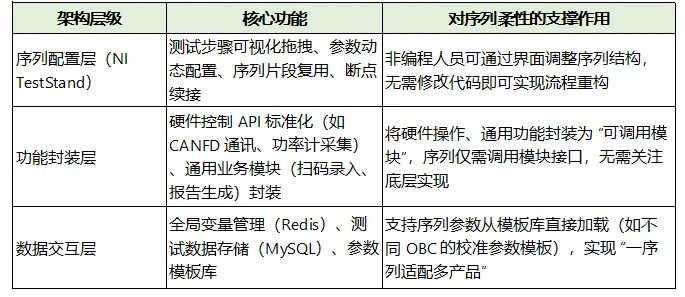
1. Core architecture for flexible sequences: “three-layer decoupling + modular packaging”
To make sequences configurable, reusable, and extensible, the software uses a layered architecture centered on NI TestStand, decoupling test sequences from hardware control and business logic:
2. Key technology choice: flexible support from NI TestStand
NI TestStand was chosen as the sequence engine because it provides inherent flexibility:
- Custom step types: hardware control, data judgment, and similar functions are packaged as standard steps (for example, “CAN FD signal send step” and “numeric range judgment step”) that can be dragged into sequences without coding;
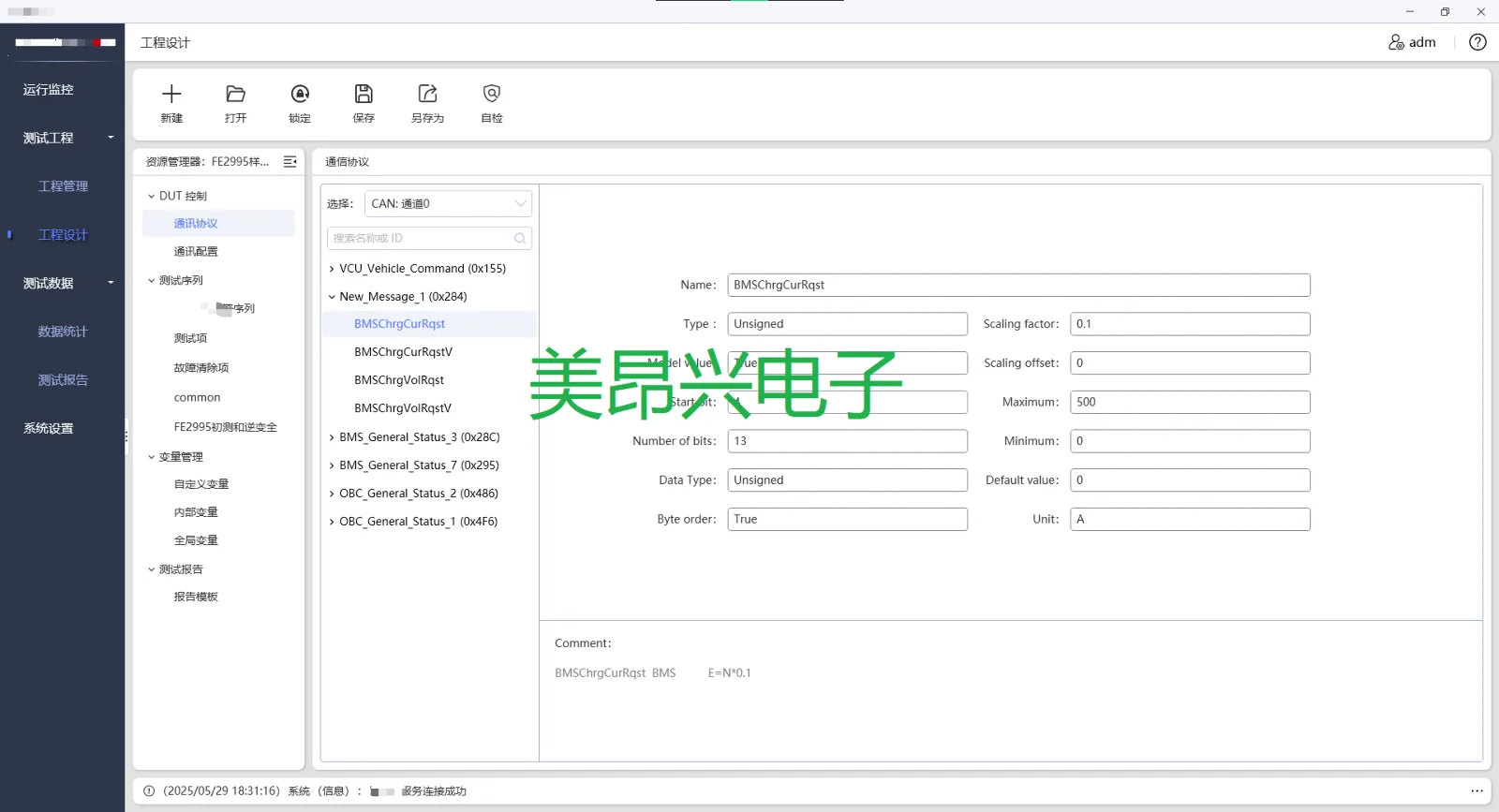
- Parameter-driven execution: test parameters (such as CC resistance thresholds and OBC set voltage) are separated from sequence logic and stored in external template files. For a new product, load the matching parameter template without changing sequence structure;
- Sequence fragment reuse: common flows (such as “equipment self-check → scan entry → test execution → report generation”) are packaged as sequence fragments that new sequences can reference directly, reducing duplicate work;
- Multi-thread scheduling: multiple products can be tested in parallel under one sequence framework; each product loads its own parameter set, so “one sequence runs multiple lines.”
III. Core Implementation Path for Flexible, Reconfigurable Sequences
1. Standard step library: ready-to-use sequence building blocks
Using NI TestStand custom step types, a standard step library was developed for the full OBC test scope, enabling flexible reuse at step level. Step categories and core design are as follows:
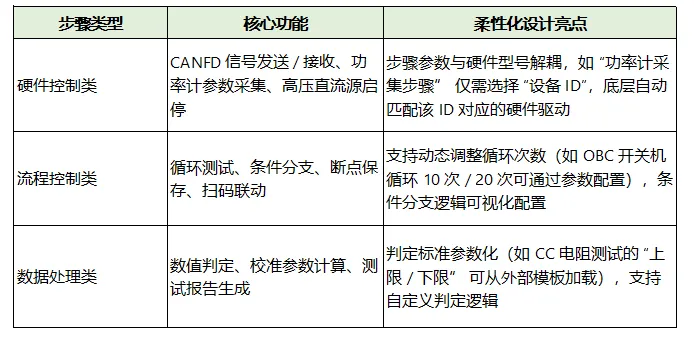
Example: to configure an “OBC calibration test sequence,” drag four steps from the library—“CAN FD signal send” (calibration command), “power meter acquisition” (voltage and current), “calibration parameter calculation” (K/B values), and “numeric judgment” (K-value accuracy)—with no code. Sequence setup can be finished in about 15 minutes.
2. Parameter template management: one sequence for multiple products
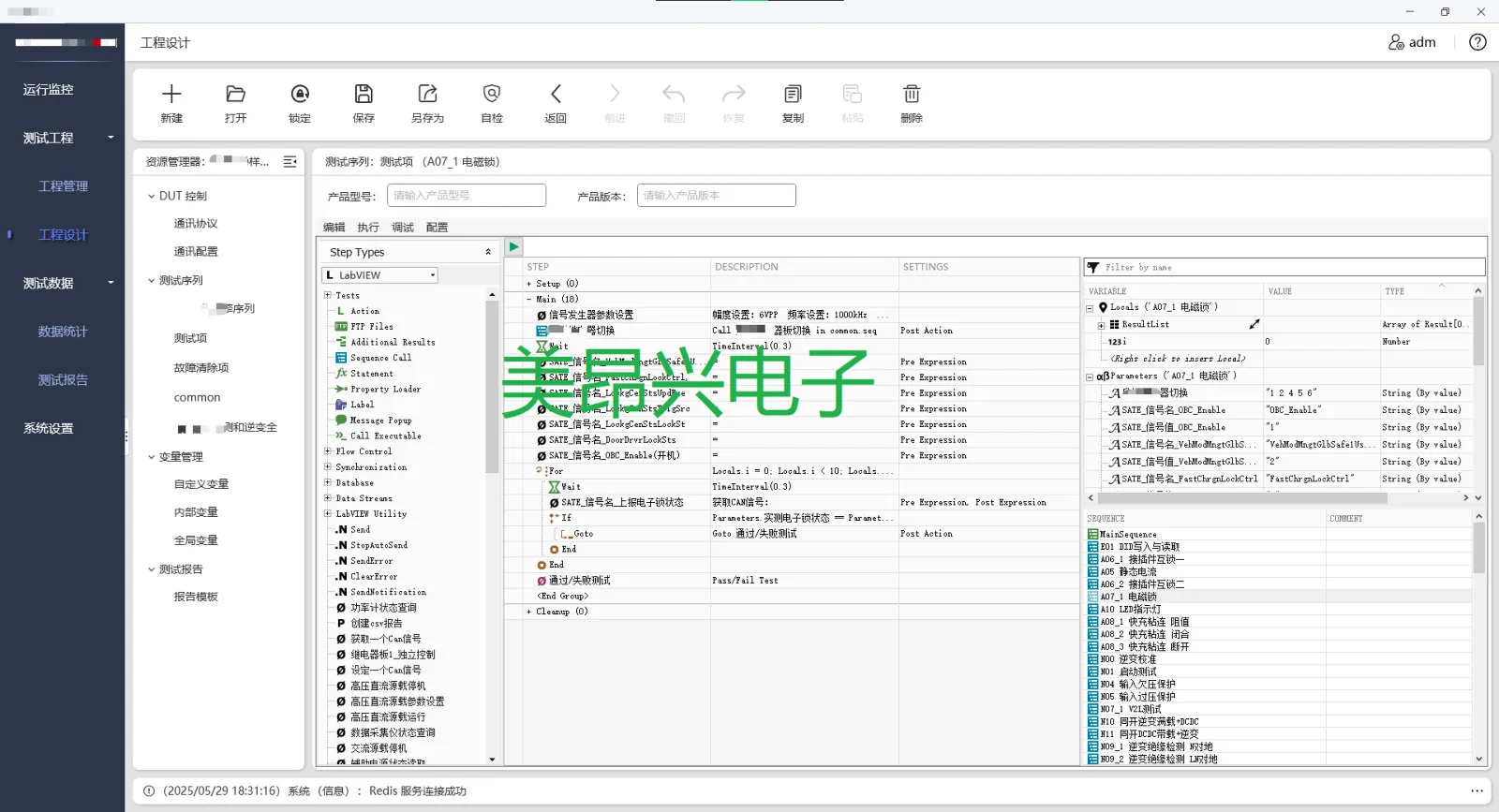
Parameter templates were built for differences across OBC models, fully separating sequence logic from parameter data. Core approach:
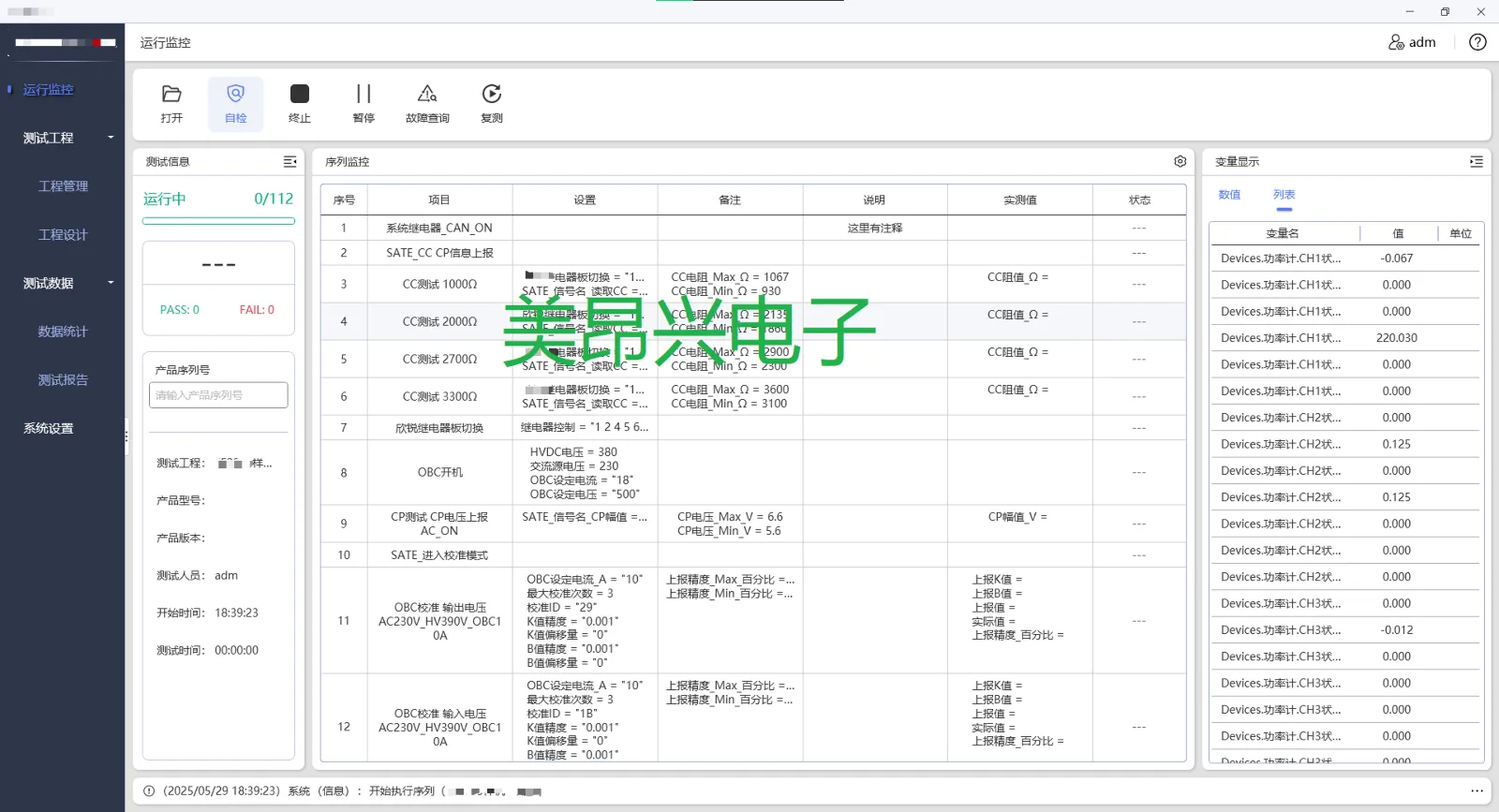
- Template file design: parameters are stored in XML templates, one per OBC product, including “test-item parameters” (for example, CC resistance test 1000 Ω step threshold 930-1067 Ω), “hardware configuration parameters” (for example, CAN FD baud rate 500 kbps, power meter sample rate 10 Hz), and “flow parameters” (for example, 10 cycle tests, 3 retests);
- Template loading: at sequence start, scan the product SN to match the parameter template (SN prefix linked to template), or select a template manually; the sequence reads parameters from the template and assigns them to the corresponding steps;
- Dynamic parameter changes: parameters can be changed in real time during a test (for example, an engineer temporarily shifts OBC set voltage from 500 V to 550 V during R&D). Changes take effect immediately without restarting the sequence.
Example: the same “OBC routine test sequence” loads the “11 kW OBC parameter template” with CC threshold 930-1067 Ω (1000 Ω step), or the “22 kW OBC parameter template” with 1860-2135 Ω (2000 Ω step). Sequence step structure stays the same—one sequence adapts to multiple products.
3. Sequence fragment reuse and composition: faster flow rebuilds
Common OBC test flows (self-check, data entry, report generation) are packaged as reusable sequence fragments that can be freely combined and nested. Core design:
- Fragment packaging rules: each fragment has “input parameters” (for example, self-check needs a hardware device list), “execution logic” (for example, check CAN FD, power meter, and high-voltage source connectivity in order), and “output results” (for example, pass/fail flag), so fragments stay independent and portable;
- Fragment composition: when creating a new sequence, pick “equipment self-check fragment” → “scan entry fragment” → “test execution fragment” → “report generation fragment” from the library and drag to assemble a full sequence without redeveloping common flows;
- Fragment version management: fragments can be versioned (for example, an improved “report generation fragment” with linked fault data). Sequences that reference a fragment sync to updates, avoiding version mismatch issues.
Example: for an “OBC fault reproduction sequence,” reference “equipment self-check fragment” (hardware OK) → “historical fault fragment” (steps at fault time) → “data acquisition fragment” (focus on fault-related parameters). Reproduction sequence setup can be done in about 30 minutes.
4. Breakpoint resume and dynamic adjustment: flexibility during testing
For test interruption (communication faults, out-of-limit parameters) and ad hoc flow changes, breakpoint resume and dynamic adjustment keep sequence reconfiguration practical:
- Breakpoint data storage: on interrupt, save “current step index,” “collected data,” “hardware state snapshot,” and “parameter configuration” to a breakpoint file so resume data is complete;
- Breakpoint resume logic: after fault clearance, the sequence reads the breakpoint file, restores hardware state (for example, reinitialize CAN FD and reload pre-interrupt parameters), skips completed steps, and continues from the interruption point;
- Real-time flow changes: insert or delete steps during a test (for example, add “electromagnetic lock status check” after “CC test”), or change step parameters (for example, shift “OBC set current” from 18 A to 20 A), with immediate effect and no sequence restart.
Example: during “OBC calibration,” a CAN FD interrupt stops the run. After repair, the sequence resumes at “OBC calibration” without rerunning “CC test” and “CP test,” saving about 20 minutes.
IV. Performance Verification and Application Value of Flexible, Reconfigurable Sequences
1. Key performance metrics
Validated on the OBC test system in real use, core performance indicators include:
- Sequence configuration efficiency: new sequence development drops from about 2 hours per suite to 15-30 minutes; when switching OBC model, adaptation drops from about 1 hour to about 5 minutes (load new parameter template only);
- Hardware adaptation efficiency: when hardware changes (for example, swapping power meter brands), the sequence stays unchanged—only the hardware driver is updated. Adaptation drops from 3-5 days to 1-2 hours;
- Fault reproduction efficiency: building a reproduction sequence from historical fault data drops from about 2 hours to within 30 minutes, with fault localization accuracy up to 100%;
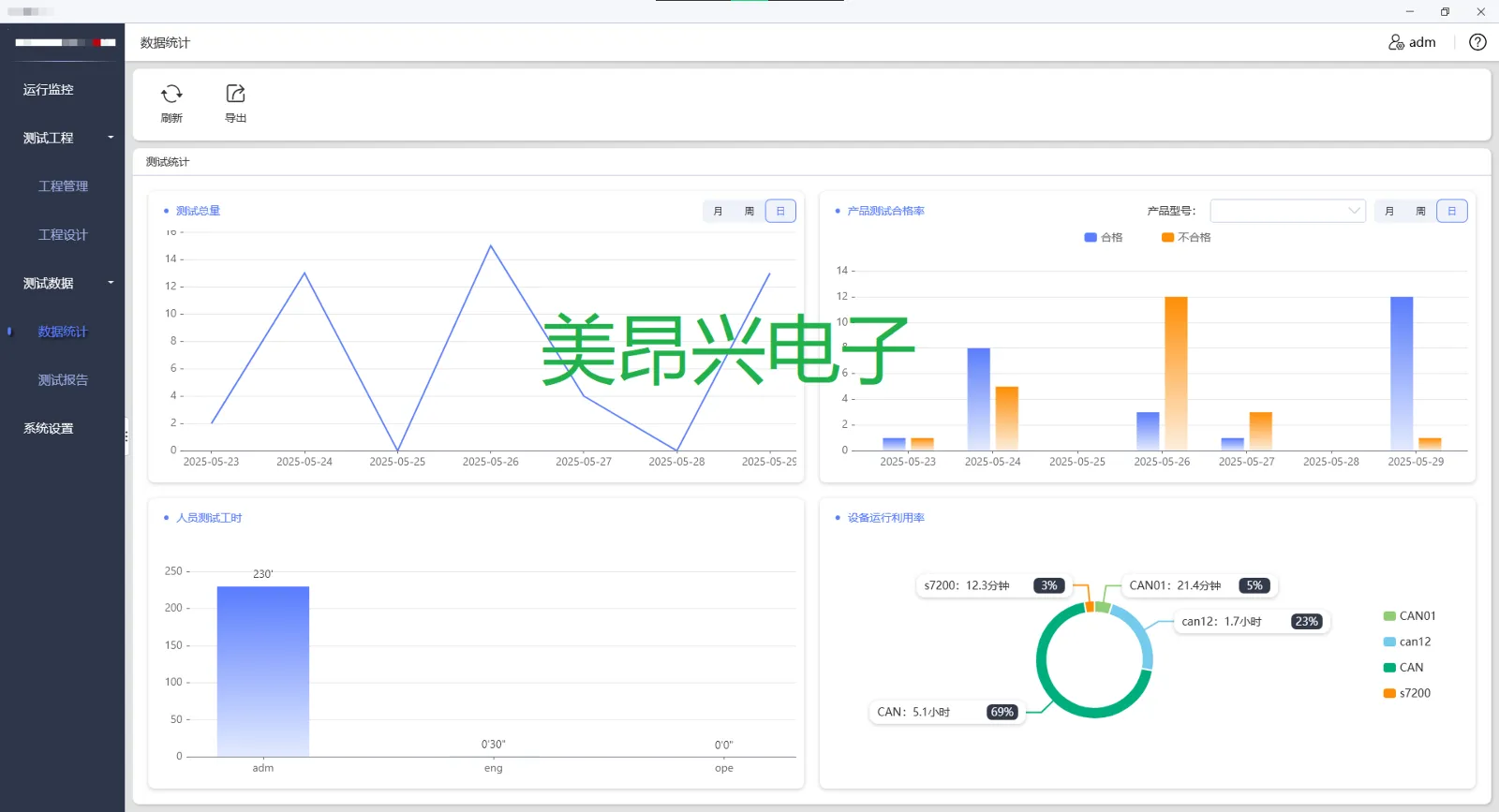
Parallel test capability: one sequence framework supports four parallel OBC production lines, each with a different parameter template, raising test efficiency by about 300% versus traditional single-sequence mode.
2. Application value
- Lower development cost: standard step libraries and fragment reuse cut duplicate development effort by about 70%; non-programmers can configure sequences in the UI, reducing reliance on dedicated developers;
- Greater adaptation flexibility: “one sequence for multiple products and hardware” means OBC product iteration and hardware upgrades do not require sequence rewrites, shortening test-system rollout;
Better test experience: breakpoint resume and real-time flow changes avoid repeating work after interruptions; single-step debugging and dynamic parameters in R&D support faster issue isolation and solution tuning.