
I. Project Background
With demand for clean energy growing, a central state-owned enterprise is actively engaged in research and production of water-electrolysis hydrogen technology. To control the water-electrolysis hydrogen process efficiently, safely, and accurately, it commissioned advanced host software for the hydrogen-production equipment, to meet its strict requirements for 24-hour uninterrupted production.
II. Technical Implementation
Language and technical framework: The software is developed in C# with WPF (Windows Presentation Foundation). C# provides strong functionality and broad class-library support, which makes complex control logic and data processing practical. WPF is used to build a polished user interface. Through XAML (Extensible Application Markup Language), layout, styles, and data binding are defined flexibly, separating the interface from business logic and making the code easier to maintain.
Architecture choice: An MVVM (Model - View - ViewModel) architecture is used for the modular design. The software is divided into three main parts: Model, View, and ViewModel. The Model manages data and business logic, such as data processing for interaction with hardware and power-supply control algorithms. The View is the user interface: it presents data and receives user actions. The ViewModel is the bridge between View and Model. It provides two-way data binding so the display stays in sync with business data in real time. The modules were developed in parallel and then integrated, which raised development efficiency and reduced coupling between modules.
Hardware interaction: A dedicated communication protocol was developed for multiple Siemens S7-1200 PLCs and multiple ITECH DC power supplies. Through this protocol the software communicates with the hardware stably and efficiently. It sends control commands to the PLCs to control the operating parameters of the water-electrolysis test bench precisely, and it receives device-status information fed back by the PLCs. For the DC power supplies, the software precisely adjusts and monitors key parameters such as output voltage and current, so the supplies provide stable energy for water electrolysis.
III. Software Functions
Automatic control: From the preset production flow and parameters, the software automatically outputs control signals and precisely regulates the operating state of the water-electrolysis test bench. From starting the equipment and adjusting reaction conditions through stopping production, the process does not require frequent manual intervention. This greatly raises production efficiency and reduces errors from manual operation.
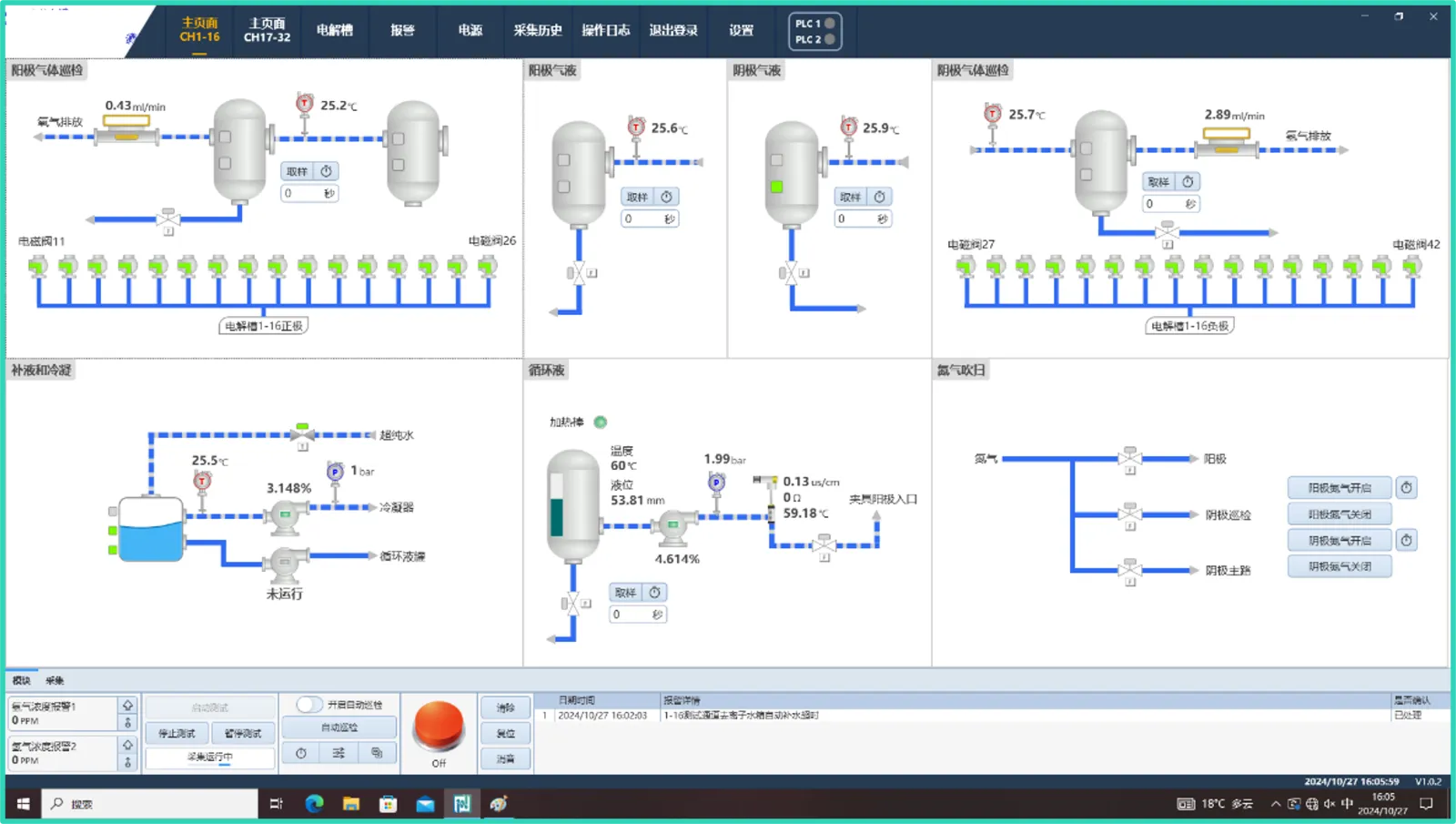
Real-time monitoring: Key parameters of the water-electrolysis process are acquired and displayed in real time, including voltage, current, temperature, pressure, and hydrogen output. The data is presented in charts, dashboards, and similar forms, so operators can see equipment status at any time and find potential problems promptly.
Data acquisition and recording: An SQLite database accurately records all data from equipment operation. Storage is structured and secure, which supports later query, analysis, and traceability. Mining the historical data can improve the production process and raise hydrogen-production efficiency.
Fault warning and alarm: Built-in fault-warning and alarm functions monitor equipment operating data in real time. If a parameter is abnormal or a fault risk appears, a warning is issued immediately. If a fault occurs, an alarm is issued promptly, showing the fault type, location, and possible cause in detail, and the corresponding emergency action is taken to protect equipment and personnel.
Report generation: Reports are generated automatically to the user's needs, including daily production reports, monthly reports, equipment operation reports, and fault-statistics reports. The reports follow a set format and are substantial in content, providing strong data support for production management and decisions.
Usable interface: The graphical interface is carefully designed to be simple and direct, and the operating flow is easy to follow. Technicians and ordinary operators can learn it quickly and readily complete tasks such as parameter setting, equipment monitoring, and report queries.
IV. Use and Results
The software is used in water-electrolysis hydrogen production and provides automatic control output 24 hours a day without shutdown. In actual operation it has markedly raised production efficiency and lowered production cost. Precise control and real-time monitoring keep the equipment running stably and reduce the fault rate. Timely fault warnings and alarms have effectively avoided major accidents and improved production safety. After the central state-owned enterprise adopted it, both hydrogen output and quality improved markedly, and its competitiveness in clean energy was strengthened further.
V. Project Summary
Through its technical implementation path, this host software for hydrogen-production equipment provides capable, practical functions and meets the central state-owned enterprise's production needs for water-electrolysis hydrogen. As the technology continues to develop, the software will keep being optimized and upgraded, further improving performance and function and providing stronger support for the water-electrolysis hydrogen industry.