
I. Project Overview
Custom-developed on the MayonX Electronics FlexTM platform, this engine water-cooling test-bench software provides comprehensive, accurate testing and monitoring of the engine water-cooling system, meeting the strict requirements of automotive technology development.
II. Technical Approach
Modular Architecture: The software follows a modular design and is divided into two main parts: the common architecture of the FlexTM test-and-measurement host software, and customer-specific communication libraries and logic blocks. The common architecture is based on the FlexTM platform and uses object-oriented design. It has good extensibility and stability, and it provides a unified runtime and interaction interface for each function module. The customer-specific part is developed for the customer's particular requirements so that the hardware and the software fit together. Custom devices are brought into the common architecture through standard device property methods, so the functions operate in coordination.
Technology Selection and Integration: NI data-acquisition hardware is used for data acquisition. Its strong acquisition capability and stability support high-accuracy capture of sensor data. Communications support TCP, LIN, CAN, and other protocols, providing stable, efficient communication with different hardware and keeping data transfer timely and accurate. With the underlying support of the FlexTM platform, the software modules are integrated and work together.
III. System Architecture
Hardware Layer: This layer includes the customer's own measurement-and-control host, NI data-acquisition hardware, electric water pumps, solenoid valves, sensors (pressure, temperature, speed, and others), and related hardware. These devices collect data from the engine water-cooling system and execute control commands issued by the software. They are the foundation of the test system.
Data Acquisition and Control Layer: NI data-acquisition hardware collects sensor data such as pressure, flow, coolant temperature, and pump speed, and sends the data to the software above. It also receives control commands from the software and precisely controls electric water-pump speed, solenoid-valve opening, and similar outputs, so the test can be regulated in real time.
Software Function Layer: Function modules developed on the FlexTM platform include hardware-device management, variable management, alarm management, logic-block programming, test-sequence editing, manual control, automatic testing, data-acquisition display, device execution logs, and report output. They provide full management of the test flow and in-depth processing of the data.
User Interaction Layer: A clear, practical user interface supports device operation, test-flow setup, and data review and analysis. Users can start and monitor the test from the manual-control screen or the automatic-test screen. On the data-acquisition display, live test data is available, and historical data can be reviewed for comparison. The report-output module provides standardized test reports.
IV. Software Functions
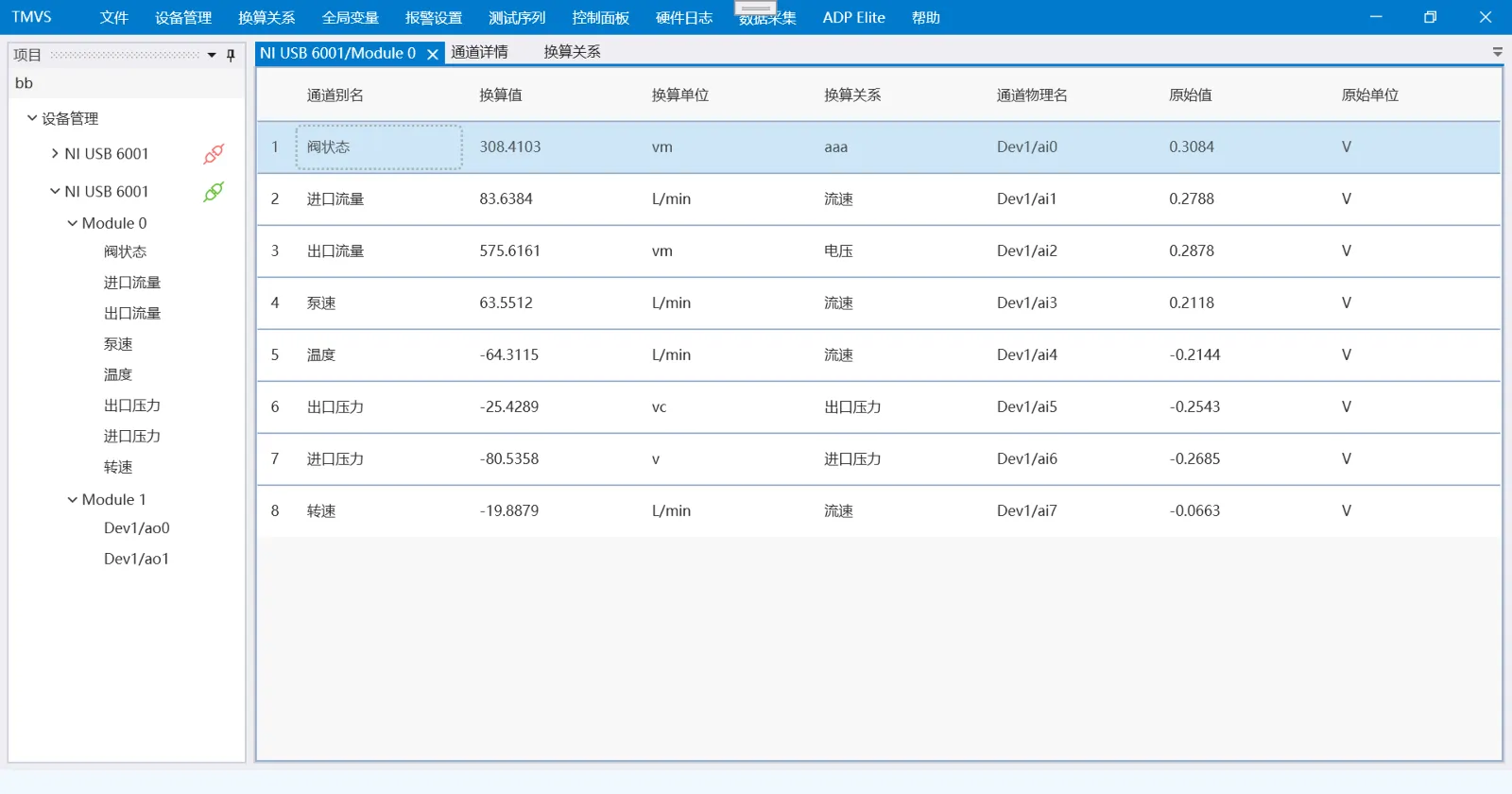
Hardware Device Management: Configured devices, modules, and channels can be selected from drop-down lists, named, and assigned a scaling relationship, so the hardware is straightforward to manage and accurately configured.
Variable Management: Hardware acquisition variables, output variables, and software process variables can be added or removed, so users can define and manage data variables to match the test.
Alarm Management: Upper and lower limits are set on variables, and an alarm logic block is selected. When data leaves the set range, an alarm is raised in time to keep the test safe.
Logic-Block Programming: Hardware operation logic is encapsulated. Some functions can be operated only by the software manufacturer, providing stable logic support for the test.
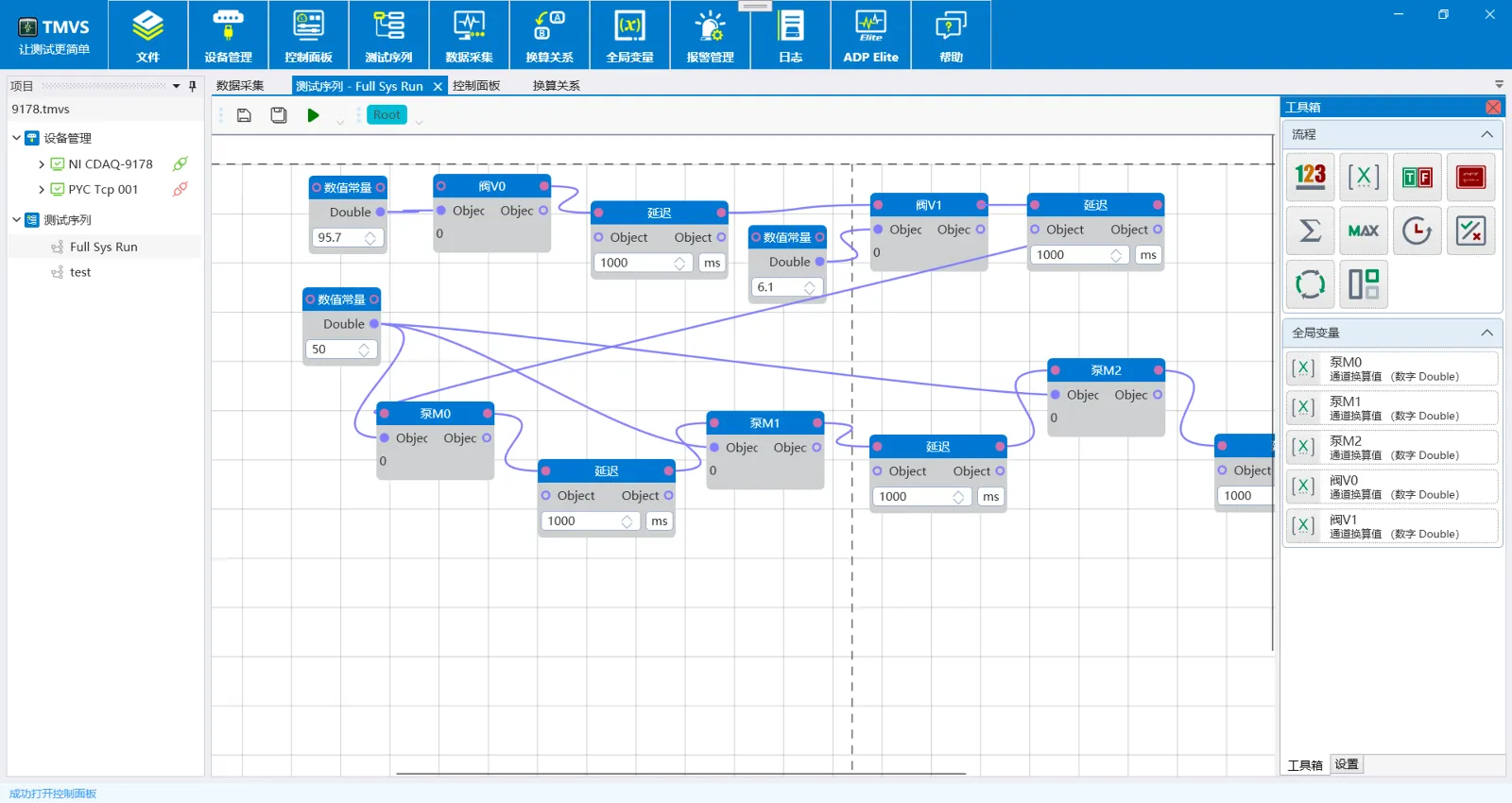
Test Sequence Editing: Users can call variables, logic blocks, and similar elements and freely combine test sequences for their own test needs, so the test flow can be designed to fit.
Manual and Automatic Testing: The manual-control screen brings together multiple controls for manual operation. On the automatic-test screen, an edited test sequence can be selected and run automatically, which raises test efficiency.
Data Acquisition Display: Sensor data is acquired and displayed in real time, and historical data can be viewed for analysis and for judging trends.
Report Output: The software automatically judges whether the data passes and outputs a report in the preset format, providing a direct basis for evaluating the test result.
Device Execution Log: Commands executed by the devices are recorded, so the test can be traced, problems investigated, and experience summarized.
V. Project Results
This project delivered host measurement-and-control software for the engine water-cooling test bench that meets the customer's requirements. Verified in actual use, the software functions are stable and reliable. It has greatly raised the bench's working efficiency and test accuracy, provided strong data support for development of the engine water-cooling system, helped the customer move product development faster and improve product performance, and produced significant results.